Event 1
Rastignac’s debut at Mme. de Beauséant’s ball
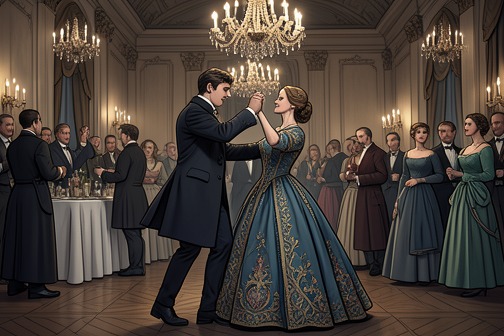
[Rastignac’s debut at Mme. de Beauséant’s ball](entity:event-recall-event-rastignac-s-debut-at-mm-27cc8411c8b3) is the first decisive opening in his effort to enter Parisian high society: a family connection carries the young law student into an aristocratic salon, where the spectacle of rank and fashion redirects his ambition toward social advancement and a beautiful countess. The evening offers him not merely a dance but the promise that doors may open through influential women; its glamour, however, is already shadowed by the money and dependency that shape the world he hopes to join.
## Causes and Invitation
While walking in the country with his sisters, Rastignac reflects on his changed outlook. His aunt, Mme. de Marcillac, had once moved in court society and among its most distinguished circles. What had seemed to her younger relatives like fairy tales now appears to Rastignac as a possible resource: the old connections might still help him succeed in [Paris](entity:location-recall-location-657453741ed3). After considering which wealthy relative might prove willing to assist, Mme. de Marcillac writes to her cousin, Mme. de Beauséant, recommending her nephew. She tells him that, if he pleases the viscountess, she may introduce him to other relations as well. The social opportunity therefore begins with deliberate family networking, not an accidental encounter.
Mme. de Beauséant replies with an invitation to her ball for the following evening. Rastignac sends his aunt’s letter a few days after returning to Paris; by the end of November [1819](entity:time-recall-time-1819-17062a53670b), the invitation has become a new prospect for the student at the [Maison Vauquer](entity:location-recall-location-maison-vauquer-0a45dfda1f61). The event gives his ambition a practical route into a society previously distant from his daily life: a relative’s introduction can secure admission where his legal studies alone cannot.
## The Ball and Its Social Promise
Rastignac later describes the occasion to the other residents of the Maison Vauquer as a splendid affair. Mme. de Beauséant’s house is magnificent, its rooms hung with silk, and he says he was as happy as a king. [Vautrin](entity:character-recall-character-vautrin-92f6c541bd88) interrupts with a pun on “king,” suggesting that kingfishers have more fun than kings. The exchange briefly punctures Rastignac’s grand description, but it does not diminish the exhilaration the evening has given him.
In retrospect, Rastignac understands the scale of the favor he has received. Mme. de Beauséant is one of the queens of fashion; her house in the [Faubourg Saint-Germain](entity:location-recall-location-348281ff0b9f) is considered among the most agreeable in that district. Her fortune and name make her a conspicuous figure in the aristocratic world. Before he understood what her patronage meant, Rastignac had already been received in her house. Admission to its gilded salons consequently feels almost like a patent of nobility: he has appeared in Paris’s most exclusive circle, and he imagines that other doors may now open.
The room first overwhelms him with its brilliant assembly. He exchanges only a few words with Mme. de Beauséant, his benefactress, before his attention settles on a different woman. The narrative makes the contrast important: the viscountess’s invitation confers access, while the countess’s beauty gives that access an immediate personal aim. Rastignac leaves the ball not with a developed understanding of the society around him, but with a powerful impression of its splendor and a new object of desire.
## Rastignac and [Anastasie de Restaud](entity:character-recall-character-anastasie-de-restau-2eff9fda1aa0)
At the ball, Rastignac is captivated by Anastasie de Restaud. She is described as tall and graceful, with large dark eyes, a strikingly shaped hand, and a shapely foot; her movements have a fiery energy. The fashionable Marquis de Ronquerolles calls her a thoroughbred and a pure pedigree, language that treats aristocratic identity as something like inherited breeding. The narrator sets those expressions against the older imagery of heavenly angels and romantic mythology, suggesting that modern fashion has replaced idealized love with a more worldly vocabulary.
For Rastignac, however, Anastasie is the woman for whom he has been longing. He writes his name twice on the list of partners on her fan and speaks with her during the first quadrille. Asking where he might meet her again, he receives an open answer: everywhere, including the Bois, the Bouffons, and her own house. The brief exchange turns fascination into apparent opportunity. In a later account, he recalls dancing with one of the most beautiful women in the room, her hair decorated with peach blossom and her bouquet composed of real flowers. His description records the sensuous vividness of the encounter, while his inability to describe her fully underscores how completely the evening has captured his imagination.
Rastignac uses his kinship with Mme. de Beauséant to establish a connection with the countess. Anastasie, whom he takes for a great lady, invites him to call at her house. Her parting smile convinces him that he must accept the invitation. The encounter is also a test of his inexperience: among fashionable young people for whom ignorance could be fatal, he happens upon someone who does not ridicule what he does not know. The ball thus gives him both a promising invitation and a reprieve from the social humiliation he fears.
## First Consequences and Retrospective Irony
The invitation to Mme. de Restaud’s house converts a night of dancing into a next step in Rastignac’s social pursuit. He later says he met the countess on foot in the Rue de Grès the following morning, an encounter that made his heart beat and prompted him to imagine what might follow. The ball’s promise now extends beyond the ballroom: a woman he has idealized appears to be within reach, and a visit to her home seems the natural continuation of their acquaintance.
Vautrin supplies a sharp counter-reading of that hopeful impression. He identifies the countess as Anastasie de Restaud, locates her home in the [Rue du Helder](entity:location-recall-location-73ebb408570d), and says she had been going to see the moneylender [Gobseck](entity:character-recall-character-gobseck-e1c6786ea848). He generalizes that, when one explores a Parisian woman’s heart, the moneylender comes before the lover. The information recasts Rastignac’s chance morning sighting and his memory of the dance: the countess’s elegant presence belongs to a world in which financial need and romantic attachment are entangled. Goriot raises his head at Vautrin’s words and looks between the speakers with such evident understanding and uneasiness that the other residents notice him. The ball’s social sparkle therefore stands at the threshold of a more troubling knowledge, even as Rastignac himself remains absorbed in the woman he has met.
## Significance
The episode marks a change in Rastignac’s sense of what is possible. A recommendation from Mme. de Marcillac secures his entrance to Mme. de Beauséant’s salon; there, he discovers that an aristocratic connection can function as social capital, giving a poor student access to a world in which a name, fortune, and invitation carry weight. His excitement is not abstract: it attaches to silk-hung rooms, a partner’s fan bearing his name, a dance, and the prospect of visiting Anastasie at home.
That rise in possibility is paired with a limit in his understanding. Rastignac sees a beautiful countess and interprets her invitation as the beginning of an exciting acquaintance; Vautrin points instead toward Gobseck and the financial pressures beneath the polished surface. The ball inaugurates Rastignac’s entry into fashionable society while establishing the gap between its alluring appearances and its material realities. Its lasting significance lies in that double movement: the student is admitted, dazzled, and set on a new course, but the first glimpse of the world he desires already carries a warning about what its attractions conceal.
Event 2
Goriot sells his silver to pay Anastasie’s debts

[Goriot sells his silver to pay Anastasie’s debts](entity:event-recall-event-69684bc9f4a1) in a secret, painful act of paternal sacrifice: he crushes a cherished wedding gift into a bar, sells plate for cash, and sends a receipted account to his daughter. The episode’s objects make his devotion tangible. Silver that once marked a household’s celebrations becomes money for a daughter who depends on him, while the old man’s tears reveal the emotional cost of converting memory into payment.
## The keepsake and the sacrifice
When Goriot first arrives at [Mme. Vauquer](entity:character-recall-character-mme-vauquer-dde5d5bb3426)’s lodging house, he brings an abundance of silver plate, along with a wardrobe that displays the comfort and pride of a prosperous retired tradesman. Among the pieces is a small silver posset dish with two turtle-doves on its cover. He explains to Mme. Vauquer that his wife gave it to him on their first wedding anniversary, spending the savings she had kept before their marriage. He says he would rather scratch the earth with his nails than part with it, and takes comfort in expecting to use it for his coffee every morning. The dish is not simply valuable household silver: it carries the memory of his wife and an earlier domestic life.
That attachment gives the later destruction its force. Goriot’s paternal generosity has long taken material form. Although he earns an income of sixty thousand francs, he spends scarcely twelve hundred francs on himself, gives his daughters the best education and accomplishments he can secure, provides them with a carriage and a chaperone, and indulges their wishes without asking more in return than a kiss. He is prepared to make his wealth serve their comfort; in this episode, he makes even a treasured reminder of his marriage serve that same purpose.
## The nighttime transformation
The scene first reaches [Eugène de Rastignac](entity:character-recall-character-eug-ne-de-rastignac-26173ab3d4fa) as an unsettling glimpse. Sitting with thoughts of Law and poverty, and imagining a future beside Anastasie, Eugène hears a sound from Goriot’s room that he mistakes for a death groan. He slips onto the landing and looks through the keyhole, where the light exposes an action whose purpose he does not yet understand. Goriot has turned the table over and secured a silver plate and cup against a bar. With a thick rope, he pulls hard enough to crush and twist the metal out of shape, apparently trying to make ingots.
The labor is physical and deliberate. Goriot unwinds the rope, covers the table with a blanket, and rolls the flattened silver into a bar with astonishing dexterity. Eugène watches his muscular arms at work and wonders whether the old man is a thief or a receiver of stolen goods, living like a beggar to conceal criminal activity. That suspicion records the scene’s initial uncertainty: from outside Goriot’s room, the destruction of costly plate looks like evidence of a hidden life, not the cost of a father’s aid to his daughter.
When the bar is nearly finished, Goriot looks sadly at what he has made. Tears fall as he extinguishes the dip that has lit his work, and Eugène hears him sigh before lying down again. The sequence shifts the meaning of the act without explaining it outright. The silver has been made saleable, but the sight of Goriot’s grief makes clear that this is no indifferent liquidation of surplus possessions. His whispered pity for a child further restrains Eugène from judging him hastily, even as the purpose of the sacrifice remains to be discovered.
## From silver to payment
The explanation comes by way of observation and a letter. [Vautrin](entity:character-recall-character-vautrin-92f6c541bd88) reports that he saw Goriot in a goldsmith’s shop on the Rue Dauphine at half-past eight in the morning, selling a piece of silver plate for a good sum. The metal had been twisted out of shape so neatly that the transformation appeared practiced. Vautrin then says he followed Goriot to the Rue des Grès, where he went into the house of the money-lender [Gobseck](entity:character-recall-character-gobseck-e1c6786ea848). The route connects the night’s labor to its economic result: a household object is altered, sold, and followed by a visit to a lender.
The episode’s practical destination becomes clearer when Vautrin intercepts Christophe carrying a letter from Goriot to Mme. la Comtesse [Anastasie de Restaud](entity:character-recall-character-anastasie-de-restau-2eff9fda1aa0). He holds the envelope to the light and determines that it contains not a banknote but a receipted account. His sardonic description of Goriot as a gallant old dotard exposes the transaction’s double character: the old man is not merely sending money, but settling an account for his daughter. The personal sacrifice takes the form of an ordinary document delivered by a servant to Anastasie’s address on the [Rue du Helder](entity:location-recall-location-73ebb408570d).
Eugène recognizes the object that has been broken up. When Mme. Vauquer asks whether Goriot really melted down his silver posset dish, Eugène recalls that the lid bore two turtle-doves and that he saw Goriot crying as he broke up the cup and plate. Mme. Vauquer confirms that the dish was dear to him as his own life. What had looked like suspicious nocturnal work is thus legible as a particular sacrifice: Goriot has surrendered a treasured object in order to meet his daughter’s financial need.
## Love measured in money
The sale belongs to a wider pattern in which Goriot’s affection is expressed through expenditure. He has raised Anastasie and her sister, [Delphine de Nucingen](entity:character-recall-character-delphine-de-nucinge-d389c7d84e40), with lavish attention, giving each half his fortune as a dowry when they married. Anastasie’s marriage to the [Comte de Restaud](entity:character-recall-character-comte-de-restaud-cb1368d454cf) carried her toward the more elevated social sphere she desired; Delphine married the banker Nucingen. Afterward, the daughters’ husbands objected to Goriot’s continuing to work in trade and then restricted the daughters’ contact with him. The old man eventually retired on the proceeds of his business and his savings, but the separation did not end his giving.
The silver episode anticipates the painful logic he later names from his deathbed. He imagines that, had he kept his money, his daughters would be beside him, tending and kissing him; instead, he has nothing. He concludes that they would have treated him with attention when he was still worth something, and that money can command the appearance of familial closeness. His earlier sacrifice is not identical to that later lament: the plate is given to discharge Anastasie’s immediate account, while the deathbed speech reckons with the cumulative cost of having spent his fortune on both daughters. But both moments expose the same vulnerability. Goriot makes material resources the language of love, and discovers that money can secure needful services or temporary regard without guaranteeing reciprocal affection.
The episode therefore places tenderness and economic exchange inside one another rather than separating them. The wedding dish stands for a private history of affection; once crushed and sold, it becomes a payment on a daughter’s behalf. Goriot’s tears register what the transaction costs him, while the receipted account and the goldsmith’s payment show how completely that feeling must pass through money to reach its practical end. The transformation from keepsake to ingot is both an act of care and a measure of the world in which care is made materially legible.
Event 3
Rastignac’s first visit to Mme. de Restaud

[Rastignac’s first visit to Mme. de Restaud](entity:event-recall-event-00c5fc4f4f9a) is a failed social debut that exposes how wealth, lineage, and appearances govern access to Parisian society. [Eugène de Rastignac](entity:character-recall-character-eug-ne-de-rastignac-26173ab3d4fa) arrives hoping to turn an aristocratic connection into a future, but his inexperienced curiosity leads him to reveal that he knows [Father Goriot](entity:character-recall-character-father-goriot-31d9231e8bb8)—whose relationship to the Countess the household is determined to conceal—and the visit ends with the Count barring him from the house.
## The Visit and Its Obstacles
The day after the preceding events, Rastignac dresses with unusual care and sets out at about three in the afternoon for the [Rue du Helder](entity:location-recall-location-73ebb408570d). On the way, he imagines himself conducting a brilliant conversation: he equips himself with clever replies and polished speeches, and invents small incidents that might lead toward the declaration on which he has built his hopes. Those romantic preparations are undone by the street itself. Walking through the mud, he has to stop at the [Palais-Royal](entity:location-recall-location-palais-royal-ad9a407b4027) to have his boots blacked and his trousers brushed.
The expense and inconvenience sharpen his awareness of what he lacks. Changing a five-franc piece he has brought in case of need, he thinks that if he were rich he would take a cab and be free to concentrate. At the Countess’s house, servants look at him contemptuously because he has crossed the courtyard on foot. A smart cab and a finely harnessed horse make visible the luxury he has only imagined, and his rehearsed wit deserts him. He waits in the antechamber, standing by a window and nearly deciding to leave, but persists through what the narration describes as a tenacity of purpose.
The servant tells him that the Countess is in her boudoir and cannot receive him, then directs him to the dining room, where someone else is waiting. Trying to demonstrate that he knows the house, Rastignac opens the wrong door and finds himself among dressers, lamps, drying towels, and hot-water pipes, beyond which lie a dark passage and a back staircase. The laughter from the antechamber deepens his embarrassment. As he turns toward the drawing room, he stumbles against a bath, just avoiding immersing his hat.
## A Glimpse That Changes the Visit
From the dark passage, Rastignac hears voices and a kiss. One voice is Mme. de Restaud’s; the other belongs to Father Goriot, his neighbor at the boarding house. The coincidence unsettles him, especially because he remembers [Vautrin](entity:character-recall-character-vautrin-92f6c541bd88)’s insinuations about Goriot. He waits in the drawing room, wanting to establish whether the man he has just heard is indeed the Goriot he knows.
A well-dressed young man comes out impatiently, complaining that he has waited more than half an hour. The servant calls him the Count, and he moves toward Rastignac, apparently curious to look at the student. The servant then reports that the Countess is free. At the same moment, Goriot appears by the gate, emerging from the door at the bottom of the back staircase. He opens his umbrella just as a tilbury enters the courtyard; its horse takes fright, swerves, and rushes toward the steps. The young man in the carriage sees Goriot and acknowledges him with constrained courtesy, the sort of respect paid to someone whose services are still needed but whose acquaintance has become embarrassing. Goriot answers with a friendly nod and a good-natured smile.
Rastignac is absorbed in the encounter and forgets that he is not alone until he hears the Countess speak to the departing young man. He turns and sees her dressed in a loose white cashmere gown with rose-colored ribbons, her hair loosely arranged. Her appearance and manner intensify the social and romantic atmosphere he had anticipated on the walk over. Yet his attention to the scene also sets up his mistake: he treats what he has witnessed as knowledge he can casually disclose, without understanding the danger attached to Goriot’s name in this house.
## The Name That Exposes a Secret
When Rastignac later explains that he saw a gentleman leave—Father Goriot, his next-door neighbor at the lodging house—the Count, who has been stirring the fire, drops the tongs as though burned. He rises to rebuke the student for using the familiar prefix Father rather than the respectful Monsieur. The Countess first pales at her husband’s vexation, then blushes and tries to answer with affected carelessness. Her reaction makes clear that Goriot’s identity is no neutral matter in the household.
The mention of Goriot reverses the effect of Rastignac’s earlier social advantage: his connection to Mme. de Beauséant had helped him, but this name produces the opposite result. The narration compares him to a visitor who accidentally knocks into a glass case of fragile figures, sending several heads tumbling. The Countess becomes reserved and chilly, avoids his eyes, and withdraws the welcome she had seemed to offer. Rastignac recognizes that he has blundered, although he does not yet know the full extent of what he has disclosed.
He attempts to withdraw politely, saying that the Countess wishes to speak with her husband and offering his good-day. She interrupts to say that both she and M. de Restaud will be delighted to see him whenever he calls. The formality of the invitation does not repair the rupture: the Count insists on accompanying Rastignac to the hall, and once the student has left, tells the servant that neither he nor the Countess is at home when that gentleman calls. Rain falls as Rastignac reaches the steps. He reproaches himself for his social ineptitude and imagines that proper entry into society requires cabs, polished boots, gold watch chains, and different gloves for morning and evening.
## What the Visit Reveals
The visit becomes a turning point in Rastignac’s understanding of Goriot’s place in the world. At a gathering later, Rastignac recounts how he had seen Goriot leave the Countess’s house by the back staircase and had told the couple that he knew the man from their poor lodging house. The [Vicomtesse de Beauséant](entity:character-recall-character-vicomtesse-de-beaus-09b9443b3167) identifies the concealed family connection: Mme. de Restaud had been Mlle. Goriot. The Duchess adds that she was the daughter of a vermicelli manufacturer, and recalls that the daughter of a pastry cook had been presented at court on the same day. Rastignac completes the recollection with the Latin phrase “Ejusdem farinoe.” The revelation places the Countess’s aristocratic standing beside the commercial origins her household now seeks to suppress.
The encounter’s humiliation therefore carries more than a lesson in dress or etiquette. The carriage in the courtyard, the servants’ glances, the wrong door, and the difference between calling Goriot “Father” and “Monsieur” all make social rank legible through small, concrete tests. Rastignac arrives imagining that wit and ambition can carry him forward; he leaves having learned that a name can expose a concealed relationship and that, in this household, Goriot’s paternal intimacy is treated as a liability. The visit brings into view both the class divisions Rastignac hopes to cross and the family history that those divisions have pushed into secrecy.
Event 4
Goriot’s daughters grow distant after marriage
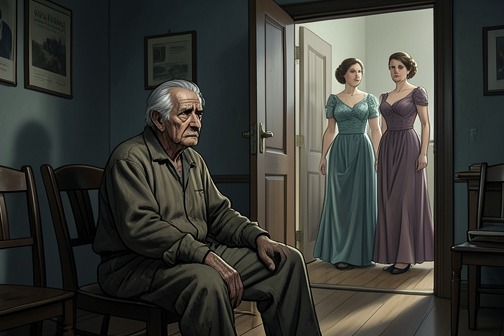
[Goriot’s daughters grow distant after marriage](entity:event-recall-event-6a07eec76b9b) as the consequences of his extravagant paternal devotion collide with the social and financial arrangements of their adult lives. He gives each a substantial dowry, retires from the business that had sustained him, and expects family affection in return; instead, their husbands restrict his access, and he takes refuge in [Mme. Vauquer](entity:character-recall-character-mme-vauquer-dde5d5bb3426)’s boarding house. The estrangement is not simple indifference: the daughters still seek him privately, while their marital finances repeatedly draw him into their affairs. The episode exposes a family order in which love persists, but access, money, and reputation determine how it can be expressed.
## Before the Marriages
Goriot’s devotion had shaped the daughters’ upbringing long before it shaped their estrangement. Though his business provided an income of sixty thousand francs, he spent scarcely twelve hundred on himself and directed the rest of his resources toward Anastasie and Delphine. He hired the best teachers, provided a chaperon, riding lessons, and a carriage, and answered their wishes without asking for repayment beyond a kiss. He loved them even when their demands caused him pain, placing them, in the narrator’s account, above himself.
When they were old enough to marry, Goriot left them free to choose. Each received half his fortune as a dowry, but they entered marriages with different aims. Anastasie’s social aspirations drew her to [Comte de Restaud](entity:character-recall-character-comte-de-restaud-cb1368d454cf) and the prospect of a more exalted position; Delphine, who wanted money, married Nucingen, a wealthy banker who later became a baron. Goriot remained in the vermicelli trade, while his daughters and sons-in-law grew uncomfortable with his continuing work in business. The marriages thus transferred wealth and altered social standing, but did not give Goriot an accepted place in the households his money had helped establish.
## Retirement and Exile
For five years Goriot resisted his family’s appeals that he retire. He eventually sold his business and lived on the proceeds together with his savings. Mme. Vauquer calculated that his remaining capital produced an annual income of eight or ten thousand livres—the modest sum he had kept for himself after providing so much for his daughters.
Retirement did not secure the family life Goriot had imagined. His sons-in-law compelled their households not to receive him as an inmate and, beyond that, restricted him from seeing his daughters except in private. He therefore took refuge in Mme. Vauquer’s boarding house, driven there by despair at the exclusion. In retrospect, the Viscountess de Beauséant describes him as a father who had expected that his daughters’ homes would become two homes of his own, where he would be loved and welcomed. Within two years, she says, both sons-in-law had effectively turned him out. The distance was not simply a matter of geography: it marked the failure of the family arrangement Goriot believed his sacrifice had secured.
## Private Visits and a Chosen Withdrawal
The daughters did not entirely abandon their father. Under the restored Bourbons, according to Mme. de Langeais’s account, their husbands became less willing to tolerate the old man’s company, but the daughters still wanted to see him. They arranged private visits when their husbands were absent, presenting these encounters as an opportunity to have their father to themselves. Their attachment remained, but it had to be concealed and scheduled around the husbands’ authority over the household.
Mme. de Langeais interprets Goriot’s withdrawal as a sacrifice made to spare his daughters difficulty. He understood, she suggests, that they were ashamed of him and that his visits could create discord with their husbands; he therefore chose what she calls voluntary exile. He believed that their apparent satisfaction meant he had done what was best. The interpretation holds together tenderness and tragedy: Goriot withdraws out of paternal consideration, but that very consideration helps make his exclusion possible. Mme. de Langeais calls the arrangement a family crime in which father and daughters were accomplices—not because they share equal power, but because the daughters’ private accommodation of the situation leaves the separation intact.
## Money Inside the Marriages
The estrangement unfolds alongside continuing financial dependence. Delphine later tells [Eugène de Rastignac](entity:character-recall-character-eug-ne-de-rastignac-26173ab3d4fa) that, despite possessing a fortune of her own, she has no control over household money: Nucingen pays the household bills, carriages, and opera box, while leaving her short of money for her clothes. Proud and reluctant to ask him for funds, she spends her savings and then money her father had given her before falling into debt. When she finally confesses, Nucingen pays the debts using her dowry, but imposes a fixed limit on her future expenses. Her account shows how a marriage that appeared materially secure could leave her financially constrained, while the habits of her upbringing—where Goriot had readily granted her wishes—remain part of the conflict.
Later, Delphine explains to her father that Nucingen has invested both his capital and hers in business speculations. She says that demanding her dowry back immediately would force him to file a petition, while waiting a year might allow him to increase her fortune through investments in building land. She reports that he has apologized, promised access to accounts for inspection, and asked her to maintain the existing household allowance while he economizes. Goriot distrusts this explanation and warns that Nucingen may be using the arrangement to retain control of her property. The disagreement brings their continuing bond into view: Delphine turns to her father with an account of her marriage and finances, and he responds as a protective business-minded parent, unwilling to accept assurances that he believes could leave her exposed.
## Continuing Attachment and Its Cost
The story repeatedly contrasts Goriot’s expectation of reciprocal family life with the conditions imposed on it. The Viscountess de Beauséant recalls that he gave each daughter five or six hundred thousand francs, expecting the marriages to secure their happiness and imagining that he would be cherished in their homes. Mme. de Langeais places that hope beside the later reality of his retirement and exclusion. Her image of affection spent until nothing remains culminates in the statement that Goriot gave his daughters both his heart and, eventually, his fortune; the daughters then left him with little social or material place in their lives. The account makes his generosity the source of both intimacy and vulnerability: he has given so much that his love cannot be separated from the financial sacrifices through which he expressed it.
Even as Goriot lies gravely ill, his attachment remains fixed on his daughters. When he recognizes Eugène, he asks whether they enjoyed themselves; [Bianchon](entity:character-recall-character-bianchon-fe90b6095c0e) reports that throughout the previous night Goriot spoke of their dancing and dresses, called them by name, and asked for Delphine and Anastasie. Goriot then looks toward the door, convinced Delphine is there. The scene does not undo the history of exclusion, but it reveals its emotional asymmetry: the daughters’ access to their father has been intermittent and managed around their marriages, while his thoughts continue to return to them. Their distance is therefore both a social condition and the painful measure of a devotion that outlasts the reciprocal domestic life Goriot had hoped to share.
Event 5
Mme. de Beauséant learns that Ajuda-Pinto will marry another

The [Vicomtesse de Beauséant](entity:character-recall-character-vicomtesse-de-beaus-09b9443b3167) learns that the Marquis d’Ajuda-Pinto will marry Mlle. de Rochefide in a sequence that turns an intimate betrayal into a public social fact. First she reads the Marquis’s departure for the Rochefides as evidence; then the Duchess confirms that the marriage is settled and the banns are to be published. The revelation breaks the security of a three-year attachment and becomes the occasion for the Vicomtesse’s fierce, unsparing advice to [Eugène de Rastignac](entity:character-recall-character-eug-ne-de-rastignac-26173ab3d4fa) about ambition, love, and survival in [Paris](entity:location-recall-location-657453741ed3).
## A private attachment in a public world
For three years, the Vicomtesse’s name has been linked with that of the wealthy Portuguese nobleman, the Marquis d’Ajuda-Pinto. Their liaison has been treated as a settled feature of fashionable life. The Vicomte de Beauséant has accepted it with outward good grace, and the Marquis has commonly been present when callers visited. The arrangement has shaped the Vicomtesse’s domestic routine as well as her public reputation: visitors arriving between two and four found themselves received so coolly that Paris learned to leave her alone during those hours.
The relationship is not merely private. The Marquis accompanies the Vicomtesse and her husband to the theater, while the Vicomte withdraws after bringing them there. The social world makes their attachment visible and accommodates it, but its tolerance does not secure the lovers against a change in circumstance. The Marquis must marry, and Mlle. de Rochefide is the chosen bride. The arrangement is already advanced enough that the banns are about to be published, although the Vicomtesse has not been told.
## The news arrives by degrees
The Marquis comes to the Vicomtesse’s apartments intending to break the news, but cannot bring himself to speak. He considers leaving and writing to her instead. His failure to tell her directly makes the arrival of Eugène de Rastignac a relief to him: the visitor offers an interruption and an apparent way out of an announcement he dreads making. The Vicomtesse, however, notices the Marquis’s involuntary response to the servant’s announcement. His brief, unmistakable pleasure at the interruption gives her reason to watch him closely.
After Rastignac arrives, the Marquis takes the Vicomtesse’s hand, kisses it, and leaves. She rushes to the gallery window and watches him enter his carriage. She listens as the Swiss repeats the destination to the coachman: M. de Rochefide’s house. The combination of the destination and the Marquis’s departure supplies what his hesitant visit had withheld. The Vicomtesse returns to her room in fear and begins a note to him, connecting his choice of destination with the engagement he has not confessed.
The Duchess makes the implication explicit. She has seen the Marquis at M. de Rochefide’s door and says that she came because she expected to find the Vicomtesse alone. Asked by her friend about the purpose of her visit, she answers that the Marquis is going to marry Mlle. de Rochefide and that the banns will be published the following day. The Vicomtesse’s expression initially remains controlled; she dismisses the news as a rumor and questions why the Marquis would marry into the Rochefide family. The Duchess answers that Mlle. de Rochefide is charming and that the Marquis is dining with her family that day: the matter is settled. The confirmation turns suspicion into knowledge, while Rastignac, still unfamiliar with the history and rules of these houses, witnesses the disclosure.
## A social wound becomes a public test
The revelation is delivered not by the Marquis but by a rival visitor who knows the arrangement and chooses to state it. The Vicomtesse maintains her composure in company, even when the Duchess’s words leave her face pale. The public setting intensifies the injury: a private attachment, long accommodated by the conventions of fashionable society, is displaced by a marriage alliance whose terms are already common knowledge to everyone except the woman most affected.
The Marquis’s departure and the Duchess’s confirmation mark two stages of the same discovery. His destination provides the first decisive sign; the Duchess’s report supplies the wedding timetable and removes the possibility that the matter is mere gossip. The contrast between the Vicomtesse’s outward control and the fear with which she returns to her room shows how social composure can conceal a private reversal without undoing it. Once the news is spoken openly, her response is not to expose her distress before her visitors, but to defend herself against the humiliation of being treated as the last to know.
## From heartbreak to counsel
After the disclosure, the Vicomtesse tells Rastignac that the world is ungrateful and ill-natured, and that trouble invites people to probe another person’s distress while presenting their cruelty as wit. She declares that she will defend herself. The personal blow thus alters the tenor of her conversation with the young law student: rather than offering him merely the conventions of fashionable society, she sets out a harder account of its power and risks.
Her counsel is deliberately severe. Rastignac, she tells him, must understand the corruption of society and the vanity that governs its men and women. He will need a wealthy, young woman of the world to help him advance, and he must guard his feelings rather than reveal them indiscriminately. The advice grows from the scene’s reversal: the Vicomtesse has just discovered that an attachment she regarded as secure could be superseded by the Marquis’s marriage plans, while the social circle knew the truth before she did.
She applies that lesson to Rastignac’s prospects. [Delphine de Nucingen](entity:character-recall-character-delphine-de-nucinge-d389c7d84e40), the wealthy sister of the Comtesse de Restaud, longs for entry to the Vicomtesse’s salon, and the Vicomtesse offers to provide the connection. Rastignac has already damaged his chances with the Comtesse by mentioning [Father Goriot](entity:character-recall-character-father-goriot-31d9231e8bb8); the Vicomtesse proposes that the father’s relationship to Delphine can now open another door. If Rastignac becomes Delphine’s chosen companion, she argues, other women may notice him because she has chosen him, and social success can generate further influence. The episode’s emotional injury is therefore also made into instruction in how status and desire operate.
## The protection she offers and its limits
The Vicomtesse offers Rastignac her name as a guide through the social world and asks him not to misuse it. Her protection is real but conditional: he must make no unworthy use of her introduction and must return her name unsullied. The promise places her in the role of mentor at the very moment her own confidence in love has been shaken. She can interpret the society that has wounded her and offer Rastignac practical access to it, even as she warns him against emotional trust.
The scene thus joins a private abandonment to a public initiation. The Marquis’s marriage plans end the apparent security of the liaison; the Duchess’s bluntness makes the change undeniable; and the Vicomtesse turns her new knowledge into a strategy for Rastignac’s advancement. Her counsel does not erase the personal cost of the discovery. Instead, it shows how, in the world of the novel, private feeling and social calculation continually press against each other: heartbreak becomes knowledge, and knowledge becomes both warning and instrument.
Event 6
Rastignac asks his family for money to advance socially
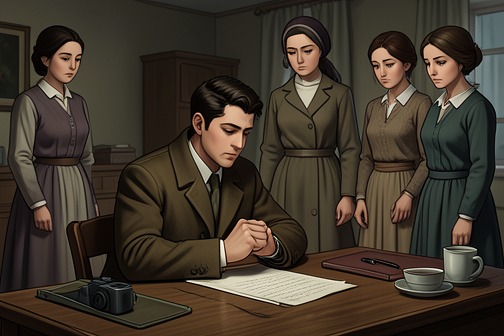
[Rastignac asks his family for money to advance socially](entity:event-recall-event-aeba8606f7c9) in [Paris](entity:location-recall-location-657453741ed3), turning his ambition into a private test of family devotion and personal conscience. He seeks twelve hundred francs to enter society under the patronage of the Vicomtesse de Beauseant; when his mother and sisters answer his appeal, their generosity enables his plans but makes their cost impossible for him to ignore.
## The Appeal and Its Purpose
After speaking with Goriot about his daughters, Rastignac goes to his room and writes to his mother. He says that he can make a rapid fortune but needs twelve hundred francs, insisting that he has not been gambling and owes no one money. He presents the expense as a requirement of his social prospects: the Vicomtesse de Beauseant is using her influence on his behalf, and he must enter society without having the means to do so himself.
His letter makes the request sound urgent and consequential. Rastignac tells his mother that he must decide whether to make his way in the world or remain in the mire, and that he wants to realize the hopes his family has placed in him. He asks her to sell old jewelry, promising to replace it with finer jewels later. The language of future success thus accompanies a present demand that his mother part with something valuable.
He also writes to his sisters, asking each for her savings and urging them to keep their sacrifice secret from the family. He expects them to respond willingly. To secure their help, he appeals to their sense of honor and affection, making their private resources part of the plan for his public advancement.
## Ambition and Misgiving
The letters do not leave Rastignac confident. As soon as he has written them, he feels misgivings and trembles at what he has asked. He imagines his sisters at the family home, counting their small store of money and devising a discreet way to send it. In his vision, their contribution is not merely financial: it requires them to undertake, for the first time, a deception motivated by unselfish love.
Rastignac recognizes the purity and tenderness of his sisters’ attachment and feels ashamed of having written. His distress sharpens when he sees the relation between their sacrifice and his intended reward. Their hard-won savings are to become a ladder by which he climbs toward [Delphine de Nucingen](entity:character-recall-character-delphine-de-nucinge-d389c7d84e40). Tears and despair accompany his ambition; the letters expose the human cost that a simple calculation of social opportunity would conceal.
When Goriot asks what is wrong, Rastignac answers that he is as much a son and brother as Goriot is a father. He then speaks of Anastasie’s danger from [Maxime de Trailles](entity:character-recall-character-maxime-de-trailles-6891da5ce48d). The exchange places Rastignac’s appeal beside Goriot’s devotion to his daughters: the young man is not indifferent to family bonds, but he is asking his own family to bear a cost in pursuit of the society in which he hopes to succeed.
## The Family’s Response
Toward the end of the first week in December, two letters arrive, one from Rastignac’s mother and one from his eldest sister. Their familiar handwriting brings him both happiness and fear. He knows their love, but also remembers how poor they are and worries that he is draining their resources. His mother sends the money he requested and cautions that she could not raise such a large sum again without her husband’s knowledge.
The mother’s letter confirms that the request has required more than a routine transfer of funds. The money is a sacrifice bounded by the family’s circumstances, not a renewable source of support. Her willingness to send it answers her son’s plea, while her warning establishes the limit of what that willingness can provide.
His sisters’ response is no less concrete. They gather their savings, travel on foot to Ruffec, and hand the money to M. Grimbert of the Messageries Royales. In her letter, the eldest sister describes the journey and the sisters’ happiness at carrying out the plan. Their help fulfils Rastignac’s request for secrecy and gives the family’s affection a material form: the money reaches Paris because they choose to spend their own small hoard on him.
## Remorse and the Cost of Success
After reading his mother’s letter, Rastignac thinks of Goriot crushing his silver keepsake into a shapeless mass to sell it and meet his daughter’s bill of exchange. The comparison turns his attention back on himself. He has condemned Anastasie for sacrificing her father to her lover, yet he has asked his mother and sisters to sacrifice their belongings and savings for his future. He asks himself which of them is worse, and finds that his judgment of another person cannot be separated from his own conduct.
He is ready to give up his attempts at advancement because he cannot bear to accept the money. The remorse is intense, but it is not the end of his ambition: his sister’s affectionate letter revives his spirits. The sequence leaves his social ascent morally unsettled. His family has helped him, and he knows the help is loving and costly; he must carry that knowledge into the society he wants to enter.
## Narrative Significance
The appeal makes the finances of social ambition intimate. What appears in Paris as a need for money is paid for by the sale of family jewelry and the surrender of savings at home. The contrast between the scale of Rastignac’s plans and the limited means of his relatives gives his advancement an obligation he cannot easily dismiss.
The episode also complicates moral comparison. Rastignac’s indignation toward Anastasie gives way when he recognizes a related pattern in his own request: other people’s resources are being spent to secure the future he desires. Yet the scene does not make the sacrifices equivalent in intention or outcome. Instead, it shows that his ambitions have already implicated the people who love him, even as his shame registers the distance between their generosity and the worldly success he hopes to gain from it.
Event 7
Vautrin's Scheme for Victorine's Fortune
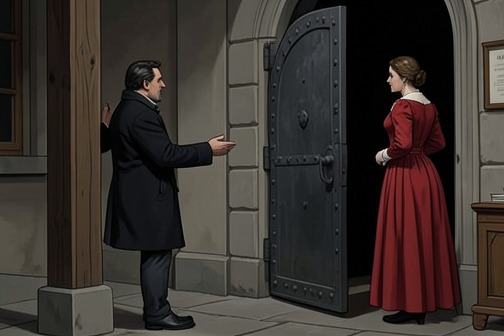
[Vautrin](entity:character-recall-character-vautrin-92f6c541bd88)’s Scheme for Victorine’s Fortune is Vautrin’s attempt to recruit [Eugène de Rastignac](entity:character-recall-character-eug-ne-de-rastignac-26173ab3d4fa) into a plot that would make [Victorine Taillefer](entity:character-recall-character-victorine-taillefer-a4d18cd7a1bd) an heiress and secure Rastignac’s rapid ascent through marriage. The bargain turns on a calculated death: Vautrin proposes to have Victorine’s brother removed so that her father will have no son to inherit his wealth. By pairing that violence with an offer of money, marriage, and a share for himself, Vautrin makes the scheme both a practical plan and a test of what Rastignac is willing to become.
## The Offer and Its Stakes
Vautrin first sets out the plan as a response to the difficulty of getting rich quickly. He tells Rastignac that success requires either starting wealthy or persuading others that one is, and describes Parisian life as a world in which advancement commonly involves dirty hands. Rather than urging Rastignac to accept ordinary limits, he encourages him to rise above the crowd and treat social rules as obstacles to be turned to his advantage.
The offer has a second purpose for Vautrin himself. He says that he has fifty thousand francs but needs two hundred thousand to carry out his own ambition: settling on a vast estate in the Southern States of America, where he imagines establishing a patriarchal life and building a fortune. He promises that if he finds Rastignac an heiress with a million, Rastignac will pay him two hundred thousand francs—an arrangement Vautrin describes as a twenty-per-cent commission. The sum is not incidental to the plot: the proposed marriage is the means by which both men expect to gain wealth.
Vautrin further sweetens the proposal by predicting that the heiress will love Rastignac and that, once married, Rastignac can obtain the money by confessing his debts to her. He claims that marriages of this kind are common among fashionable young men in [Paris](entity:location-recall-location-657453741ed3). His argument recasts deception as ordinary practice and personal advantage as a sensible response to the city’s social order.
## The Proposed Route to an Inheritance
Vautrin identifies Victorine’s father, [Taillefer](entity:character-recall-character-taillefer-38cb65645c3d), as a banker who intends to leave his fortune to his son rather than to Victorine. He alleges that Taillefer committed murder during the Revolution, but the scheme’s immediate logic rests on the inheritance arrangement: while the son lives, Victorine remains excluded from the fortune. Vautrin casts himself as a defender of the weak, saying that he dislikes the injustice done to Victorine, yet his proposed remedy is to engineer the brother’s death for Rastignac’s benefit and his own.
Vautrin presents Victorine as gentle and amiable, and predicts that her feelings for Rastignac will deepen if he devotes himself to her. In his account, that devotion will lead to marriage and help persuade her father to favor her. But Vautrin’s plan does not depend on persuasion alone. He claims that he knows Taillefer is unlikely to have more children and proposes that the brother’s death will leave Victorine as the sole child and prospective heir. His language of providence and protection therefore disguises a deliberate attempt to control who lives, who inherits, and whom Rastignac marries.
He also uses the plot to advance a broader doctrine of expediency. Vautrin advises Rastignac not to remain bound to opinions or promises, arguing that a talented person accepts circumstances and turns them to personal ends. In this way, the inheritance plot becomes an applied lesson: Victorine’s affection, her father’s fortune, and her brother’s life are all treated as elements to be arranged toward success.
## Rastignac’s Temptation and Resistance
The offer acquires force because Rastignac is in debt and under pressure. When Vautrin later appears as others discuss a possible engagement between Rastignac and Victorine, he tells Rastignac not to decide in a moment of agitation. He takes out a pocketbook and displays three banknotes, offering what Rastignac might need; the student owes money to the Marquis d’Ajuda and the Count de Trailles and lacks the means to meet those obligations. The cash makes Vautrin’s abstract proposal immediate, while the debt explains why the temptation is difficult to dismiss.
Rastignac nevertheless refuses to place himself under an obligation to Vautrin. He says that, after what has passed between them, he cannot accept the money. His response does not erase his financial difficulties, but it marks a boundary between the social ambition that Vautrin appeals to and participation in Vautrin’s conspiracy. The episode’s tension lies in the gap between Rastignac’s material vulnerability and his reluctance to accept the means being offered.
The scheme briefly appears to have succeeded. Vautrin later tells Rastignac that the arrangement is made and that two fashionable men have fallen out and will meet the next morning at the redoubt at Clignancourt. He predicts that by half past eight Victorine will be her father’s sole heiress, and claims that he has devised a sword thrust for the encounter. Rastignac listens in bewilderment and cannot answer. Vautrin’s confident account makes the consequence of the proposal plain: the inheritance is to be secured not by a legitimate change of favor but by a planned confrontation intended to remove Victorine’s brother.
## Meaning and Consequences
The scheme joins money, marriage, and violence into a single mechanism. Vautrin presents each step as practical: make a wealthy match, secure the inheritance, pay the intermediary, and convert the resulting capital into a larger fortune. Yet the plan’s smoothness is itself revealing. Victorine’s future is treated as a transaction, her brother’s death as a necessary adjustment, and Rastignac’s conscience as an impediment that can be overcome by debt and the promise of advancement.
The episode also sharpens the contrast between Vautrin’s certainty and Rastignac’s hesitation. Vautrin calls himself a man who acts according to his own design and urges the younger man to do the same; Rastignac is drawn toward wealth and position but does not straightforwardly accept the criminal bargain. The proposal thus functions not merely as an inheritance plot but as a moral trial: it gives Rastignac a concrete opportunity to pursue success through Vautrin’s methods, while showing the danger of confusing worldly opportunity with rightful gain.
Event 8
Rastignac's Debut in Parisian Society
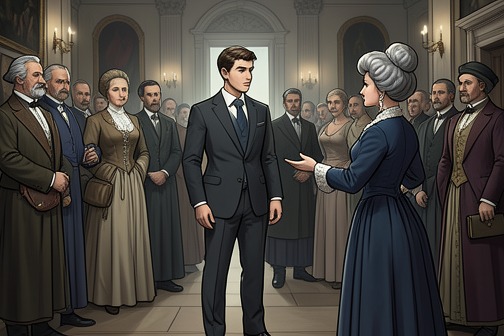
Rastignac’s debut in Parisian society is the point at which [Eugène de Rastignac](entity:character-recall-character-eug-ne-de-rastignac-26173ab3d4fa) turns family connections into social access and begins to understand that Parisian standing depends on networks of patronage, visibility, and calculated attachment. Recommended by his aunt to [Mme. de Beauseant](entity:character-recall-character-mme-de-beauseant-7ae376674bce), he enters the fashionable world through her protection, meets [Delphine de Nucingen](entity:character-recall-character-delphine-de-nucinge-d389c7d84e40), and discovers that a successful introduction can make him conspicuous before he has earned distinction on his own. The occasion advances his ambitions while exposing the moral compromises that may accompany them.
## Background and Introduction
After returning to [Paris](entity:location-recall-location-657453741ed3), Rastignac begins to see that diligent study alone will not deliver the kind of success he wants. His aunt, Mme. de Marcillac, had been presented at court and moved among the highest social circles. What had once seemed to her younger relatives like fairy tales now appears to Rastignac as practical knowledge: old family ties might still be useful. His aunt considers which wealthy relation might assist him and judges Mme. de Beauseant the likeliest to receive him. She writes on his behalf, explaining that the Vicomtesse could introduce him to other relatives if he pleased her.
A few days after Rastignac sends the letter, Mme. de Beauseant replies with an invitation to a ball. By the end of November [1819](entity:time-recall-time-1819-17062a53670b), his position has changed: he is no longer relying solely on his work at the [École de Droit](entity:organization-recall-organization-cole-de-droit-d7d16bd0775b), but has a possible route into society through a well-connected relative. The introduction does not itself guarantee advancement; it gives him access to the people and rooms in which advancement can be pursued.
## Entry into the Social World
Mme. de Beauseant makes that access tangible by taking Rastignac with her to the fashionable theatre. They travel through Paris in her brougham and enter a box facing the stage, where the audience’s lorgnettes turn toward the Vicomtesse and her young companion. For Rastignac, the spectacle feels like sudden transport into another world. The theatre is not merely a venue for entertainment: it makes his arrival visible to an audience whose attention is part of the social currency he seeks.
Mme. de Beauseant points out Delphine de Nucingen in a nearby box, while [Anastasie de Restaud and Maxime de Trailles](entity:relation-recall-relation-anastasie-de-restaud-44979b5f0baf) are elsewhere in the theatre. She agrees to help Rastignac encounter Delphine, and Marquis d’Ajuda introduces him to her in her box. He presents Rastignac as Mme. de Beauseant’s cousin and remarks, half-jokingly, that the young man has been so impressed by Delphine that bringing him nearer to her will complete his happiness. Delphine smiles and offers him the seat her husband has just left. The introduction places Rastignac beside her in public, making a potential personal connection visible to the surrounding company.
The social strategy behind the introduction is explicit. Mme. de Beauseant explains that Delphine wants admission to her salon, is jealous of her sister, and has already sought influence through [M. de Marsay](entity:character-recall-character-m-de-marsay-eb696b47b653), who cares little for her. If Rastignac becomes the person who introduces Delphine to Mme. de Beauseant, he may become important to her. The Vicomtesse also predicts that other women may be drawn to him once Delphine appears to have chosen him. In this world, an introduction can serve both as a personal favor and as a public signal that raises the recipient’s value.
## A Network Becomes a Reputation
After leaving the theatre, Rastignac walks back from the [Théâtre-Italien](entity:location-recall-location-th-tre-italien-41bc4ac9f9a2) to the [Rue Neuve-Sainte-Geneviève](entity:location-recall-location-rue-neuve-sainte-gen-e3f0297c0fa5), already making plans. He notices that [Anastasie de Restaud](entity:character-recall-character-anastasie-de-restau-2eff9fda1aa0) had watched him closely while he sat beside Delphine and infers that the Countess’s doors may no longer be closed to him. His prospects now seem to include four important houses, and he imagines himself supported within Paris’s inner social circle. He recognizes that he must attach himself to a spoke in the social machinery that can turn and lift his fortunes, although he has not yet fully calculated the methods or consequences.
His thoughts reveal both the promise and the danger of this new position. He considers that Delphine’s interest might help him learn how to manage her husband’s influence and perhaps gain access to a fortune-making opportunity through the [Baron de Nucingen](entity:character-recall-character-baron-de-nucingen-787515b174b6)’s speculation. These remain hazy possibilities rather than a settled plan, and the narrative distinguishes his early calculations from [Vautrin](entity:character-recall-character-vautrin-92f6c541bd88)’s more complete cynicism. Yet it also presents his entry into society as a gradual moral accommodation: small transactions and deviations from principle can draw an ambitious newcomer toward the relaxed morality of his age.
## The Ball and Its Consequences
The following day, Mme. de Beauseant takes Rastignac to the Duchesse de Carigliano’s ball. The Marechale receives him graciously, and Delphine is there, dressed in a way that seems intended to attract admiration and to shine particularly in his eyes. Rastignac understands that he is no longer present merely as a student accompanying his cousin. Because he is associated with Mme. de Beauseant and is already credited with Delphine’s conquest, he becomes a conspicuous figure. He catches envious looks from other young men and hears people wondering at his luck; women predict his success.
Delphine, afraid of losing his interest, promises that evening not to refuse the kiss he had struggled to obtain the previous day. The promise shows how quickly the public perception of their connection begins to affect their private interaction. Rastignac’s new social visibility gives him leverage, while Delphine’s attention helps confirm that visibility to the company around them. He receives several invitations, and Mme. de Beauseant presents him to other women of the highest fashion, launching him into what the narrative identifies as the most fashionable society in Paris. The evening becomes a remembered first triumph, compared to a woman’s recollection of her first ball.
## Patronage, Performance, and Moral Stakes
The debut is built through a chain of intermediaries: Mme. de Marcillac supplies the family connection; Mme. de Beauseant provides the invitation, access, and social guidance; d’Ajuda makes the presentation; and Delphine’s visible interest attracts further attention. Rastignac’s position changes not because he has already proved himself within this world, but because influential people recognize and display him. His cousin’s name works as a credential, while his proximity to Delphine becomes a form of public endorsement.
Mme. de Beauseant’s counsel makes the cost of such advancement plain. She describes the world as a contest in which a person must calculate coldly, guard private feeling, and use connections without being used by them. She also warns Rastignac about the estrangement between Anastasie and Delphine, whose rivalry persists despite their shared grievance of having rejected their father. Her own advice is not an uncomplicated endorsement of ruthlessness: she gives Rastignac her name as a guide through the social labyrinth and insists that he return it unsullied. The debut therefore carries a tension between opportunity and obligation. Rastignac has entered the rooms he sought, but his first success begins the question of what he will do with the access—and what that access may make of him.
Event 9
Rastignac's Roulette Winnings for Delphine
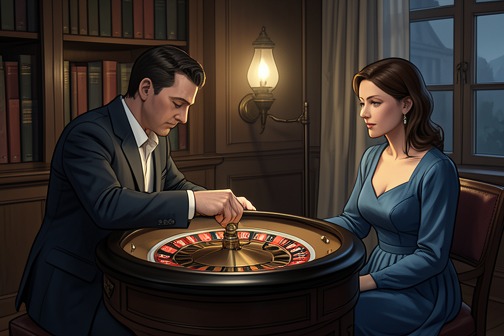
[Rastignac's Roulette Winnings for Delphine](entity:event-recall-event-rastignac-s-roulette-wi-b4b5910b1894) is the episode in which [Eugène de Rastignac](entity:character-recall-character-eug-ne-de-rastignac-26173ab3d4fa) answers [Delphine de Nucingen](entity:character-recall-character-delphine-de-nucinge-d389c7d84e40)’s urgent appeal by staking her last hundred francs at roulette and returning with seven thousand. His unexpected winnings rescue her from immediate financial pressure; in return, she discloses the marital and financial circumstances she had withheld. The episode turns Rastignac’s declaration of devotion into an act with material consequences, and makes money both the instrument of relief and a measure of intimacy.
## Causes and Background
Delphine has told Rastignac that her troubles are too painful to explain, and that his affection is still only the conventional gallantry men use to disguise their intentions. Rastignac refuses to let the subject drop. He says he wants to prove he loves her for herself and insists she must tell him what is wrong, even if helping her requires him to kill several men; otherwise, he threatens to leave and never return. Faced with that insistence, Delphine agrees to put him to the test immediately.
Her test is a gamble rather than a request for a conventional loan. Delphine asks whether Rastignac has ever visited a gaming-house; when he answers that he has not, she says she can breathe again and predicts he will have luck. She gives him her purse, containing one hundred francs—she describes it as all she can call her own—and directs him to a roulette table near the [Palais-Royal](entity:location-recall-location-palais-royal-ad9a407b4027). He must either lose the money or bring her back six thousand francs. She will explain her troubles only after he returns.
## What Happens
Rastignac accepts the purse and obeys despite admitting that he has no idea what he is doing. He asks a second-hand clothes-dealer for directions and goes to the nearest gaming-house, at number 9. At the table he asks where to place his stakes, drawing the attention of the regular players. An elderly man explains that a louis placed on one of the thirty-six numbers wins thirty-six louis if that number comes up.
Rastignac stakes all his money on number 21, his own age, and wins. Still ignorant of the game, he follows the old man’s advice to take his money off, then stakes again, this time on red. He wins again. The banker pays him another three thousand six hundred francs, bringing his winnings to seven thousand two hundred francs. The elderly adviser warns that red has already appeared eight times and urges him to leave with the money. Rastignac gives the man ten louis, then goes downstairs with seven thousand francs, stunned by his luck and still not understanding the game.
When Rastignac returns, he asks Delphine where she will take him and shows her the money. She throws her arms around him, but the embrace is not passionate: she is overcome by relief, and says that he has saved her. Her tears and gratitude follow directly from the successful gamble, which has delivered far more than the six thousand francs she asked him to win.
## Delphine’s Disclosure
With the immediate crisis eased, Delphine explains the contradiction between her apparent wealth and her lack of money. She says that although she has a fortune of seven hundred thousand francs, her husband, [M. de Nucingen](entity:character-recall-character-m-de-nucingen-33c9e5684718), does not let her control even a penny. He pays household bills, the carriage expenses, and the opera box, but deliberately gives her too little for her clothes and keeps her secretly reduced to poverty. She says pride prevented her from asking him for money.
Delphine describes how the debts accumulated. At the beginning of her marriage, she found it impossible to ask her husband for funds; she used her savings, then the money her father had given her, and finally borrowed. When she eventually confessed to debts incurred for jewelry and other small extravagances, Nucingen was angry and told her she would ruin him. He paid the debts because he controlled her dowry, but set a limit on her future expenses, which she accepted to avoid further conflict. She characterizes the marriage as a farce and says that she and her husband occupy separate rooms.
She also connects her present vulnerability to a former lover, whom she had wanted to gratify and who later abandoned her. In her account, his earlier generosity made his departure especially painful: she had believed that someone who gave money to a woman in need should not later forsake her. Her explanation exposes a pattern in which romantic attachment, financial dependence, and pride have become entangled. The account is Delphine’s disclosure to Rastignac, not an independent account of the marriage; the episode establishes what she tells him and why she says she cannot ask her husband for support.
## Consequences and Significance
Delphine tells Rastignac she is free and happy again and promises to live simply and spend nothing. She keeps six of the banknotes and says that, in conscience, she owes him a thousand crowns because she ought to share the winnings with him. Rastignac’s first response is resistance: his conscience objects to accepting the money. Delphine then frames his position as a choice between being her accomplice and her enemy, and he takes it, calling it a reserve stake in case of misfortune. The exchange leaves the rescue neither a simple gift nor a settled debt: Delphine claims a share for him, while he treats the money as a safeguard against future trouble.
The scene gives material form to Rastignac’s promise to prove his love. He does not merely listen to Delphine’s distress; he risks the small sum she entrusts to him and returns with enough to meet the amount she named. Yet his success is strikingly accidental: he has never been to a gaming-house, does not understand the game, and wins twice in succession before leaving with the advice of a stranger. The episode’s reversal—from a purse of one hundred francs to seven thousand—makes luck the immediate cause of relief, while the subsequent disclosure reveals the sustained pressures behind Delphine’s need.
Money also shapes the terms on which the two speak of affection. Delphine says she will tell Rastignac everything after he returns, and her account treats money shared between lovers as inseparable from the feeling that binds them. At the same time, the cash has an explicit accounting: she sets aside six banknotes, calculates what she owes him, and he keeps the remainder as a reserve. The scene therefore links emotional trust to a practical transfer without resolving the tension between generosity, debt, and dependence. Its decisive consequence is that Rastignac becomes the confidant to whom Delphine entrusts both her immediate need and the explanation of her troubled marriage.
Event 10
Frédéric Taillefer's Duel and Mortal Wounding

Frédéric [Taillefer](entity:character-recall-character-taillefer-38cb65645c3d)’s duel and mortal wounding are the violent turning point in [Vautrin](entity:character-recall-character-vautrin-92f6c541bd88)’s plan to make [Victorine Taillefer](entity:character-recall-character-victorine-taillefer-a4d18cd7a1bd) her father’s heiress: the duel follows a deliberately engineered quarrel, and the predicted sword thrust to the forehead is reported as fact the next morning. Frédéric is unconscious and expected to die; his injury makes Victorine’s inheritance suddenly imminent. The boarding house responds by calling her new fortune a windfall, while Rastignac’s horrified protest marks the human cost beneath that language of opportunity.
## Causes and Background
Vautrin presents the duel not as a spontaneous clash but as the intended result of his own intervention. He tells Rastignac that two young men have fallen out, that the quarrel has been conducted in proper form, and that his “pigeon” has insulted his “hawk.” The men are to meet the following morning at the redoubt at Clignancourt. In Vautrin’s account, the apparent conventions of a duel conceal a design: the violence is meant to alter Victorine’s prospects by removing the obstacle represented by her brother, Frédéric.
The announcement is chillingly specific. Vautrin predicts that by half-past eight Victorine will be her father’s sole heiress, calmly having breakfast while the family fortune and affections pass to her. He says Frédéric is an expert swordsman and confident in his ability, yet claims to have invented a thrust that will defeat him: raising the point of the sword and driving it at the forehead. The lightness of Vautrin’s phrasing, including his amusement at his own description and offer to demonstrate the technique, makes the anticipated injury sound like a practical trick. His prediction turns a human life into a calculated step in an inheritance scheme.
Rastignac hears the plan in dazed bewilderment and cannot answer. Vautrin, by contrast, interprets the student’s silence as evidence of strength and readiness, praising him as an eaglet born to command. That praise does not establish Rastignac’s agreement; his immediate inability to respond leaves him visibly shaken by what he has heard. The difference between Vautrin’s confident orchestration and Rastignac’s stunned reaction establishes the moral tension surrounding the duel before news of the injury arrives.
## The Duel and the Report of Injury
The following morning, Vautrin remains composed over coffee as the consequences of the duel become known. A servant from [M. Taillefer](entity:character-recall-character-m-taillefer-7ceb0c77b160)’s household rushes into the room, his frightened face and recognizable livery identifying him before he can explain. He reports that Victorine’s father is asking for her and that something terrible has happened: Frédéric has received a sword thrust in the forehead during a duel. The doctors have given him up, and he is unconscious; Victorine may scarcely arrive in time to say goodbye.
The report closely matches Vautrin’s forecast. The location specified for the duel was the redoubt at Clignancourt, and the distinctive forehead wound was the very thrust he had described. The narrative thus presents the injury not as an unforeseen accident but as the outcome Vautrin anticipated and engineered. His prior disclosure makes the servant’s news a confirmation of the scheme, while the urgency of the message shifts the matter from a plot discussed in the boarding house to a family crisis measured in the possibility of a final farewell.
Vautrin answers the news by lamenting the young man’s death in a tone that treats the duel as absurd given the income at stake: Frédéric, he remarks, could have had a certain income of thirty thousand livres. His comment briefly acknowledges the lost life but immediately frames the event in monetary terms. Rastignac’s sharp cry of “Sir!” interrupts that casual calculation. Where Vautrin treats the duel as an instrument and its result as predictable, Rastignac responds to the report as something that demands moral protest.
## Inheritance and the Boarding House’s Response
The consequence is stated plainly by [Mme. Vauquer](entity:character-recall-character-mme-vauquer-dde5d5bb3426): Frédéric’s death would oblige his father to acknowledge Victorine, making her an heiress. Her comment calls the change a windfall, turning the threatened death of one young person into the sudden fortune of another. Vautrin makes the transformation even more explicit when he tells Rastignac that Victorine had no money the day before and now has several millions to her fortune. The shift in her status is abrupt, enormous, and inseparable from the reported injury.
Mme. Vauquer addresses the event through a string of commonplace observations about death, the young dying before the old, and women’s different hardships. Her conventional remarks soften the shock into familiar conversation, but they also reveal how quickly the boarding house can absorb the calamity into talk of Victorine’s inheritance. Her exclamation that Rastignac has landed on his feet further draws him into the imagined benefits of the outcome, although the account does not show him accepting them. At that moment, [Father Goriot](entity:character-recall-character-father-goriot-31d9231e8bb8) notices the crumpled letter still in Rastignac’s hand, a detail that keeps the student’s personal distress visible amid the room’s speculation about money.
## Consequences and Significance
The duel makes Vautrin’s proposed route to Victorine’s fortune concrete: Frédéric’s mortal injury changes the expected distribution of family wealth, and Victorine is treated as the prospective beneficiary. Yet the event does not present that change as a clean rise in fortune. It binds her new prospects to her brother’s unconsciousness and likely death, while the servant’s urgent message insists on the possibility that she may arrive too late to say goodbye. The word “windfall” cannot erase that cost; it exposes the ease with which the household translates grief into financial advantage.
The episode also sharpens the contrast between calculated violence and moral response. Vautrin’s advance knowledge, technical description of the wound, and cool response to its confirmation make the duel part of a deliberate scheme. Rastignac’s bewilderment before the news and protest after it register his resistance, but the evidence leaves his eventual decision about the scheme unresolved. The injury therefore marks both an inheritance reversal and a test of how the people around it understand human life: as a person facing death, or as an obstacle whose removal produces millions.
Event 11
Rastignac refuses to marry Victorine
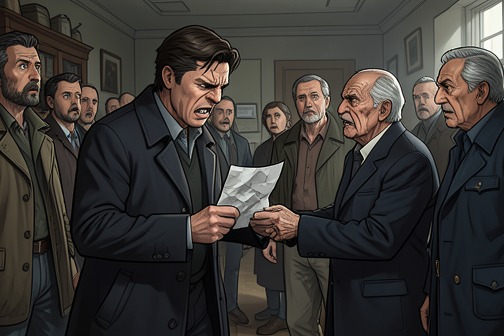
[Rastignac refuses to marry Victorine](entity:event-recall-event-rastignac-refuses-to-ma-87d50464f6b0) when her sudden inheritance makes the match materially tempting. In front of the residents of [Mme. Vauquer](entity:character-recall-character-mme-vauquer-dde5d5bb3426)’s boarding house, he declares that he will never marry her, his terror and loathing startling those present. Goriot, who has seen the crumpled letter Rastignac is still holding, takes the student’s hand warmly. The refusal becomes a visible choice against [Vautrin](entity:character-recall-character-vautrin-92f6c541bd88)’s scheme—and a brief affirmation of feeling between the young student and the old man—even as a messenger from Mme. de Nucingen calls Rastignac back into the social world he is trying to enter.
## The Inheritance That Changes the Stakes
Victorine’s sudden change in fortune provides the immediate pressure behind the decision. Vautrin remarks that she had no money the day before and now possesses several millions. Mme. Vauquer calls it a windfall and observes that her father will have to acknowledge her. The inheritance therefore alters Victorine’s position at once, transforming a rejected daughter into a wealthy prospective bride.
Vautrin directs the implication toward Rastignac: the young man has, in Mme. Vauquer’s phrase, landed on his feet. The possibility is not presented as an abstract marriage prospect. It follows a scheme that has made Victorine’s fortune available through a violent reversal in her family circumstances, and it invites Rastignac to benefit from that reversal. His refusal rejects the personal advantage that Vautrin’s plan has suddenly placed within reach.
## The Refusal Before the Boarding House
The decision takes place in public, amid the household’s response to Victorine’s changed fortunes. While others remark on the windfall, Goriot notices that Rastignac has not finished reading the crumpled letter in his hand. He asks what this means and whether Rastignac intends to be like the rest of them. The question makes the letter and the student’s response part of the same moment: Goriot is watching for what Rastignac will choose, not merely for how he will react to Vautrin’s proposal.
Rastignac turns to Mme. Vauquer and says that he will never marry Victorine. His expression of terror and loathing surprises those witnessing the scene. The refusal is thus more than a quiet reservation or postponement; it is an emphatic rejection voiced before the people who have just heard that marriage to Victorine has become a route to wealth. The contrast between the new fortune and Rastignac’s visibly horrified answer gives the moment its force.
## Goriot’s Response and the Competing Summons
Goriot answers the refusal with a physical gesture. He catches Rastignac’s hand and grasps it warmly, with such feeling that he could have kissed it. The gesture distinguishes his response from the boarding house’s talk of a windfall: where the others see Victorine’s millions as a sudden advantage, Goriot responds to the student’s choice. His concern had already surfaced when he saw Rastignac still holding the unread letter and challenged him not to become like everyone else.
The moment does not leave Rastignac outside the pressures of Parisian society. A messenger from Mme. de Nucingen asks whether there is an answer; Rastignac replies that he will come directly. The refusal of Victorine’s hand therefore coincides with his continued movement toward Mme. de Nucingen. He does not renounce ambition or withdraw from the social contest. Instead, the scene sets his rejection of Vautrin’s proposed marriage against the other demands on his attention, ending with him still in violent excitement and asking what can be done when there are no proofs.
## Narrative Significance
The episode makes the inheritance a test of character as well as a plot reversal. Vautrin’s pointed observation about the millions exposes the material reward attached to marrying Victorine; Rastignac’s answer rejects that reward in the strongest terms available in the scene. Goriot’s warm grasp of his hand gives the refusal an immediate human consequence: the choice is recognized and welcomed by someone whose own life is bound up with paternal devotion and the costs of money-driven relationships.
Yet the ending preserves the conflict rather than resolving Rastignac’s broader situation. The messenger’s arrival and Rastignac’s promise to come directly pull him toward Mme. de Nucingen, while his question about the lack of proofs shows that the crisis surrounding Vautrin’s scheme remains unsettled. The episode records a clear boundary—Rastignac will not marry Victorine—without suggesting that he has escaped the world of calculation, danger, and social ambition in which that choice has been made.
Event 12
Michonneau's Plot to Expose Vautrin
[Michonneau's Plot to Expose Vautrin](entity:event-recall-event-michonneau-s-plot-to-ex-fd1347535432) is the covert operation by which [Mlle. Michonneau](entity:character-recall-character-mlle-michonneau-842b51c30c2d) helps the police identify the lodger [Vautrin](entity:character-recall-character-vautrin-92f6c541bd88) as the escaped convict [Jacques Collin](entity:character-recall-character-jacques-collin-26c24f5ab0b7). A carefully administered drug, an intimate examination, and an ordinary breakfast custom turn the [Maison Vauquer](entity:location-recall-location-maison-vauquer-0a45dfda1f61) into the setting for an arrest: the plot succeeds not through open confrontation, but by exploiting the house’s routines and Vautrin’s own confidence in his control of events.
## The Police Approach
Two days after [Eugène de Rastignac](entity:character-recall-character-eug-ne-de-rastignac-26173ab3d4fa) insists that he is not Vautrin’s accomplice, [Poiret](entity:character-recall-character-poiret-79f1caf9554e) and Mlle. Michonneau sit in a little-frequented alley in the [Jardin des Plantes](entity:location-recall-location-jardin-des-plantes-4d8f3a747deb) with [M. Gondureau](entity:character-recall-character-m-gondureau-d58f927efc7f), a police agent. Gondureau tells them that the Minister of Police is personally interested in the matter. The appeal to high authority is calculated to impress Poiret, who accepts the official assurance as decisive.
Gondureau states that the man lodging at the Maison Vauquer under the name Vautrin is a convict who escaped from penal servitude at Toulon. Among convicts, he is known as Trompe-la-Mort, a nickname attributed to his survival of dangerous undertakings. The disclosure transforms a suspicious lodger into the target of a police investigation, while making Michonneau and Poiret potential instruments of the authorities.
## The Identification Scheme
Michonneau asks what she would have to do if she agreed to identify the fugitive for two thousand francs. Gondureau describes a concealed test: a drug in a small bottle is to be added to wine or coffee. It will cause a rush of blood to the head and make Vautrin collapse as if in a fit, without harming him. While he is believed to need attention, Michonneau is to help undress him and strike him on the shoulder; the identifying letters will then appear.
The arrangement depends on the appearance of caretaking. Michonneau is not asked to challenge Vautrin or search him openly, but to use the commotion around his apparent illness to examine his body. The plan’s practical simplicity also makes its moral and financial terms plain: an official secret is exchanged for payment, and an ordinary gesture of assistance becomes a police test.
## A Routine Turned into an Operation
The plot’s immediate cause of success is Vautrin’s own drugged wine. At a convivial gathering the previous evening, he has given drugged wine to Eugène and [Father Goriot](entity:character-recall-character-father-goriot-31d9231e8bb8). The episode is already compromised when [Bianchon](entity:character-recall-character-bianchon-fe90b6095c0e), flustered with wine, forgets to bring up Trompe-la-Mort with Michonneau; saying the name might have alerted Vautrin. Michonneau, who had nearly decided to warn him and bargain for help escaping that night, instead goes with Poiret to the chief of detectives and settles the details of the operation.
On the following morning, the household’s late start creates the opening. Several residents sleep unusually late, and breakfast is delayed. Vautrin leaves before eight and returns just as the meal is ready. As [Sylvie](entity:character-recall-character-sylvie-20cad0cd2875) and Christophe go upstairs to summon the lodgers, Michonneau comes down first and pours the contents of the phial into Vautrin’s silver cup, which is among the cups kept in the bain-marie to warm the cream for morning coffee. Her choice relies on a familiar household practice rather than a conspicuous act of intrusion.
The operation unfolds amid competing personal concerns. As Eugène comes downstairs, a commissionaire delivers a letter from [Delphine de Nucingen](entity:character-recall-character-delphine-de-nucinge-d389c7d84e40), who has waited for him until two in the morning and asks for a reassuring message. The letter briefly draws the scene toward Eugène’s private obligations, even as the poisoned cup quietly sets the police plan in motion. The boarding house’s ordinary breakfast thus gathers together the domestic, romantic, and criminal strands of the episode.
## Exposure and Immediate Consequences
Vautrin’s drugged wine ultimately brings about his ruin. When the dose takes effect, he rises with remarkable vigor, looks at Eugène, and predicts that luck comes while a person sleeps before falling stiff and motionless as if dead. Michonneau calls the collapse a stroke. Eugène, distressed and eager to escape what he regards as a scene of horror, leaves under the pretext of fetching a doctor; Vautrin is carried carefully up the narrow staircase and laid on his bed.
The apparent fit makes the planned examination possible and exposes Vautrin’s concealed identity as Jacques Collin, the notorious escaped convict called Trompe-la-Mort. The sequence is structured around a reversal: Vautrin has secretly drugged Eugène and Father Goriot at the gathering, but on the next morning it is Vautrin who receives a drug through his own cup. His confidence does not protect him from a scheme built on observation, domestic access, and the cooperation of people he has underestimated.
Michonneau’s change of course is part of the operation’s stakes. She had considered warning Vautrin and improving her position by helping him escape, but the detective’s satisfaction leads her to suspect that the police have a larger objective than capturing a fugitive. Her suspicions are not dispelled when the chief of detectives insists that the authorities’ interest concerns Vautrin’s criminal influence; she nevertheless proceeds with the identification. The episode therefore presents the exposure as both a police success and the result of Michonneau’s calculated choice among possible bargains.
## Narrative Significance
The plot makes the Maison Vauquer’s routine an instrument of surveillance. The shared meal, the warmed coffee, the silver cup, and the customary response to a collapsed lodger are not incidental background: together they provide the access the police operation needs. Vautrin’s exposure takes place through apparently ordinary hospitality, with a phial hidden in a familiar object and a bodily examination disguised as concern for his health.
The episode also sets rival forms of calculation against one another. Vautrin uses drugged wine to manipulate Eugène and Father Goriot, while the police use a drug to reveal Vautrin; Michonneau moves between warning him, bargaining with him, and cooperating with the authorities. The reversal does not make the boarding house a place of justice in any simple sense. Instead, it shows how power works through secrets, inducements, and access to other people’s bodies, until the man who has seemed to direct events is carried upstairs as a helpless patient.
Event 13
Jacques Collin (Vautrin) is arrested
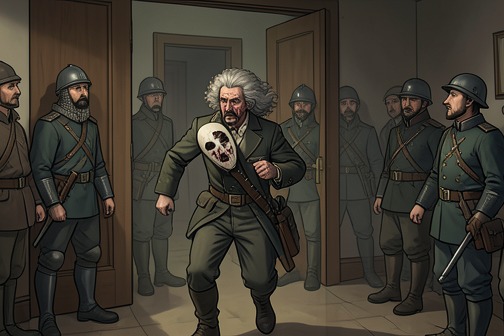
[Jacques Collin (Vautrin) is arrested](entity:event-recall-event-a085153d10ce) at [Maison Vauquer](entity:location-recall-location-maison-vauquer-0a45dfda1f61) when [Bianchon](entity:character-recall-character-bianchon-fe90b6095c0e)’s mention of the alias Trompe-la-Mort triggers the exposure of his concealed identity. The scene turns the boarding house from a setting of everyday communal life into a sealed police operation: armed men and soldiers block the exits, Collin’s wig is knocked away, and the lodgers see the convict beneath the mask of good nature. His sudden fury gives way to deliberate submission, but the arrest does not settle the room’s moral judgment; afterward, the lodgers direct their disgust toward [Mlle. Michonneau](entity:character-recall-character-mlle-michonneau-842b51c30c2d), whose part in the exposure is now plain to them.
## Causes and Background
The arrest begins with a remark by Bianchon. He recalls that Mlle. Michonneau had spoken two days earlier about a man called Trompe-la-Mort, and suggests that the name suits [Vautrin](entity:character-recall-character-vautrin-92f6c541bd88). The comment is not an official accusation, but Vautrin’s response makes its force unmistakable: he turns pale, staggers back, and fixes Mlle. Michonneau with a look so intense that she shrinks and collapses into a chair. The previously genial appearance has fallen away, and the lodgers witness a threat they do not yet understand.
The sudden change gives way to the sound of approaching force. Footsteps and the ring of rifles on the street announce that the police have arrived with soldiers nearby. An officer declares the arrest in the name of the King and the Law, while the room’s astonishment nearly swallows his words. The collision between the private conversation that names Trompe-la-Mort and the public authority now entering the house makes the arrest feel at once exposed and prearranged: the lodgers are present for the revelation, but most do not understand the danger until the officers appear.
## The Arrest and Revelation
The police enter from the sitting room and secure the house rather than relying on a single approach. Three men advance with hands on cocked pistols; two policemen hold the sitting-room entrance, two more appear at the staircase doorway, and soldiers are heard in the garden. With the routes out covered, the lodgers’ attention turns instinctively to Trompe-la-Mort. The chief walks straight up to him and strikes his head, knocking off his wig and uncovering Collin’s face.
The exposed appearance makes the contrast between the assumed identity and the man beneath it physical. Collin’s short, brick-red hair and powerful frame accompany a look of unmistakable ferocity; the disguise no longer contains the force the lodgers had only partly perceived. He starts back with savage energy and a growl, while the police reach for their pistols amid the alarm. The arrest is therefore also a public unveiling: those gathered in the room are made to reinterpret Vautrin’s past conduct, present manner, and doctrines in light of the convict they now see.
## Fury, Restraint, and Submission
For an instant Collin appears ready to turn the arrest into a violent confrontation. The narration figures his anger as a force capable of sending mountains flying, then shows it checked in a moment by a thought that crosses his mind. Rather than attack the armed men, he begins to smile and looks down at the wig that has just fallen. His self-command changes the immediate course of the scene: the police still hold the advantage, but the prisoner’s restraint is his own action, not simply the result of being physically overcome.
Collin addresses the chief with sardonic composure, remarking that the officer is not in the politest of moods. He then offers his hands to the policemen and calls on those present to witness that he makes no resistance. The room responds with admiration at the speed of the reversal—from explosive fury to controlled compliance. His submission does not erase the menace of the moment; instead, it displays a capacity to govern the same force that had just alarmed the lodgers. As the police and soldiers take him away, the arrest closes off escape without turning into the violent struggle the room seemed to anticipate.
## The Lodgers’ Judgment Afterward
Once the authorities have left, [Sylvie](entity:character-recall-character-sylvie-20cad0cd2875) breaks the silence by observing that Vautrin was a man, for all that. Her remark releases the room from its immediate shock. The lodgers look at one another, then turn together toward Mlle. Michonneau, crouched beside the stove with her eyes lowered. Their reaction recasts her earlier fear and the exposure of Vautrin: the discovery of the convict’s identity has also made her own role visible to the household.
The response is collective and nearly unanimous. The lodgers’ repulsion, previously felt but unexplained, now gathers around Mlle. Michonneau; Bianchon tells [Poiret](entity:character-recall-character-poiret-79f1caf9554e) quietly that he will leave if she remains to dine with them. Poiret is the exception to the room’s shared opinion, and Bianchon, strengthened by the majority, asks him to make her understand that she must go at once. Thus the arrest’s immediate consequence inside Maison Vauquer extends beyond the prisoner’s removal. The household turns its attention to the person whose disclosure helped bring the police to its door, and the scene ends with the community’s rejection of her.
Event 14
Frédéric Taillefer’s fatal duel
[Frédéric Taillefer’s fatal duel](entity:event-recall-event-d6ee66ff02a8) is the sudden reversal that makes his sister [Victorine Taillefer](entity:character-recall-character-victorine-taillefer-a4d18cd7a1bd) a wealthy heiress: challenged by Count Franchessini of the Old Guard, he is struck in the forehead with a sword and dies that afternoon. His death changes Victorine’s prospects, sends her from [Mme. Vauquer](entity:character-recall-character-mme-vauquer-dde5d5bb3426)’s boarding house to live with their father, and gives [Eugène de Rastignac](entity:character-recall-character-eug-ne-de-rastignac-26173ab3d4fa) a fortune he explicitly refuses to pursue through marriage.
## The Duel and Its Report
The news first reaches the boarding house through the Pilote, a Radical newspaper edited by M. Tissot. The paper appeared several hours after the morning press and served country subscribers by carrying news to provincial districts a day ahead of ordinary local journals. [Bianchon](entity:character-recall-character-bianchon-fe90b6095c0e) draws attention to its account: Frédéric challenged Count Franchessini, a member of the Old Guard, who drove a couple of inches of steel into his forehead. The report immediately presents the duel not only as a death but as a reversal of fortune: Victorine, once an overlooked young woman, is now one of the richest heiresses in [Paris](entity:location-recall-location-657453741ed3).
## Death and Its Immediate Consequences
The fatal outcome is confirmed later by a messenger’s letter to Mme. Vauquer. She reads it and collapses into her chair before announcing that Frédéric died at three o’clock that afternoon. The news also carries practical consequences for the household: [Mme. Couture](entity:character-recall-character-mme-couture-0277b3ee2fe7) and Victorine ask to have their belongings sent because they are going to live with Victorine’s father, [M. Taillefer](entity:character-recall-character-m-taillefer-7ceb0c77b160). He permits Victorine to keep Mme. Couture as her companion. Their departure leaves four rooms to let and, as Mme. Vauquer laments, five lodgers gone. In the boarding house, a family’s sudden rise in fortune registers as vacancies and lost income.
## Victorine’s Inheritance and Rastignac’s Choice
Frédéric’s death makes Victorine rich, but it does not make her Rastignac’s chosen bride. When Bianchon asks whether Victorine had been in love with him, Rastignac says he will never marry her: he is in love with a charming woman who loves him in return. Later, [Father Goriot](entity:character-recall-character-father-goriot-31d9231e8bb8) tells [Delphine de Nucingen](entity:character-recall-character-delphine-de-nucinge-d389c7d84e40) that Rastignac has given up Mlle. [Taillefer](entity:character-recall-character-taillefer-38cb65645c3d) and her millions for her, adding that Victorine had loved him and was now rich as Croesus. Delphine responds by declaring that she will love Rastignac for ever. The inheritance thus becomes both a material temptation refused and a measure of the commitment he makes to Delphine.
## Narrative Significance
The duel’s consequences expose the precarious arithmetic of fortune in the novel. A violent death abruptly alters Victorine’s status, while the same change creates an opportunity Rastignac rejects in favor of his attachment to Delphine. The sequence moves from a newspaper’s brisk account of steel in the forehead, through Mme. Vauquer’s shocked calculation of departing lodgers, to Goriot’s disclosure of the millions Rastignac has set aside. Death, inheritance, housing, and courtship converge: Frédéric’s loss is at once a family catastrophe, a financial transformation, and a test of Rastignac’s stated choice.
Event 15
Mme. de Beauséant’s farewell ball

[Mme. de Beauséant’s farewell ball](entity:event-recall-event-0bbf7665d227) is at once a social spectacle and a private leave-taking: [Paris](entity:location-recall-location-657453741ed3) comes to witness a great lady’s fall, while she receives its gaze with sovereign composure, burns a casket tied to her former happiness, and prepares to withdraw from the world. Rastignac stays beside her until she departs before dawn, and returns to the [Maison Vauquer](entity:location-recall-location-maison-vauquer-0a45dfda1f61) newly conscious of the moral landscape around him.
## Causes and Public Stakes
The ball is held as the news of Marquis d’Ajuda’s impending marriage spreads through Parisian society. [Delphine de Nucingen](entity:character-recall-character-delphine-de-nucinge-d389c7d84e40) tells Rastignac that the king is to sign the marriage contract the next day, that Marquis d’Ajuda will not attend, and that Mme. de Beauséant does not yet know what is happening. Though the secret has been kept from her, the news has become public knowledge, and the city is already anticipating her response. Delphine expects the gathering to draw everyone: she says she will attend, partly for Rastignac’s sake.
The event’s cruelty lies in the gap between its formal appearance and its actual purpose. Mme. de Beauséant cannot cancel the ball, while the crowd arrives eager to see her at the moment of her fall. The guests are styled as her friends, but their presence turns the rooms into an audience chamber for her misfortune. The narrator compares the sensation to the court’s attendance on an unfortunate princess in the time of Louis XIV: the scale of the gathering makes private heartbreak into public theatre.
## The Ball and Its Audience
Five hundred carriages illuminate the darkness around the Hotel de Beauseant, and gendarmes stand on either side of the brightly lit gateway. The rooms on the ground floor are already full when Mme. de Nucingen and Rastignac arrive. The crowd includes Paris’s most beautiful women, ministers, ambassadors, and distinguished courtiers, their decorations and ribbons filling the salons with the visible emblems of rank. The orchestra’s music rises in waves from the palace’s golden ceiling, but the setting is described as desolate because its queen is about to disappear from it.
Mme. de Beauséant receives the guests in white, without ornaments in her braided hair. Her face shows neither pride nor pain nor a joy she does not feel; the narrator likens her stillness to Niobe carved in marble. Only a few intimate friends can detect satire in her smile. The guests admire her as though she were a gladiator facing death with a smile, and society itself seems dressed for one final audience with a sovereign. The comparison exposes the ball’s reversal: the woman whose rank once made her the centre of attention is now treated as a spectacle, while her ability to maintain composure becomes the last form of authority she can command.
When Mme. de Beauséant tells Rastignac that she feared he would not come, he promises to be the last to leave. His presence distinguishes loyalty from curiosity: he is not there merely to watch her suffering, but to accompany her. The promise becomes a practical act of fidelity when he remains with her after the public gathering has run its course and eventually puts her into her traveling carriage.
## The Private Farewell
In her room, preparations for a journey make the ball’s deeper purpose plain. Mme. de Beauséant tells Rastignac that the guests have arrived early, but that her death will be long in coming; she is speaking of the end of her life in Paris, not a literal death. At five that morning she intends to set out for the remotest part of Normandy and bury herself there. Since three in the afternoon she has been signing documents and setting her affairs in order. Her broken-off words leave the depth of her sorrow visible without supplying what she cannot bring herself to say.
She asks Rastignac to perform one last service and gives him a small casket that once held her gloves. Before balls or the theatre, she had opened it believing herself beautiful because she was happy, and had used it to preserve gracious memories. Now, she says, the casket holds much of the former self who no longer lives. The object condenses the change the ball has made visible: the woman who once entered society in happiness turns a familiar accessory into a relic of a life she is leaving behind.
Before they go downstairs, she prays that Rastignac will remember her and says that she will pray for him. She insists that people must not think she is weeping, and distinguishes the public world she is leaving from the solitude ahead, where no one will ask the reason for her tears. She takes one last look around, covers her eyes, wipes away her tears, washes her face with cold water, and takes the student’s arm. The deliberate return to self-command does not erase grief; it shows the effort by which she refuses to let the audience dictate how that grief will appear.
## Departure and Consequences
Near five in the morning Rastignac puts Mme. de Beauséant into her traveling carriage and receives her farewells amid fast-falling tears. The narration undercuts any ideal of invulnerable greatness: no rank can exempt a person from human affection or pain. The woman who stood before the guests like a marble figure finally weeps as she leaves, and the contrast makes her composure an act of endurance rather than evidence that she feels nothing.
Rastignac returns on foot through the cold and darkness to the Maison Vauquer. The narrator says that his education is nearly complete. The farewell has shown him both the vanity of social spectacle and the hurt it can conceal: an elite crowd can gather around suffering without relieving it, while a private gesture of loyalty matters precisely because it is not performed for that crowd. The ball thus marks not only Mme. de Beauséant’s withdrawal from Paris but a turning point in Rastignac’s understanding of the world he is learning to enter.
## Narrative Significance
The episode makes the ball’s ceremonial surface serve two opposed purposes. In the salons, rank, decoration, music, and a flood of carriages stage the power of Parisian society; in the private room, a little glove casket and the arrangements for a solitary journey register what that spectacle costs. The shift from the crowded ground floor to the farewell in Mme. de Beauséant’s room moves the reader from public curiosity to intimate loss without separating the two: the ball’s audience is part of the pressure under which she makes her departure.
Her refusal to let the guests see her tears preserves dignity, but the final tears and Rastignac’s promise to remain until the end keep that dignity from becoming an image of invulnerability. The farewell consequently joins two outcomes: Mme. de Beauséant leaves the world of Parisian society, while Rastignac returns to it with fewer illusions. The night does not make suffering noble by itself; it reveals the difference between a crowd’s appetite for another person’s downfall and the steadfastness of the one companion who stays.
Event 16
Père Goriot’s death and funeral
[Père Goriot’s death and funeral](entity:event-recall-event-3346f3f5ae1a) bring the novel’s paternal tragedy to its material and moral conclusion. In his last delirium he recognizes that his daughters have not come, yet his love keeps returning to them; after his death, [Eugène de Rastignac](entity:character-recall-character-eug-ne-de-rastignac-26173ab3d4fa) and [Horace Bianchon](entity:character-recall-character-horace-bianchon-683e00fee96b) arrange a burial the family will not provide. The funeral’s pauper’s coffin, borrowed five francs, and two empty aristocratic carriages reduce the contrast between filial devotion and social display to a few stark objects. At Père-Lachaise, Rastignac’s grief ends his youth and hardens into a challenge to [Paris](entity:location-recall-location-657453741ed3).